
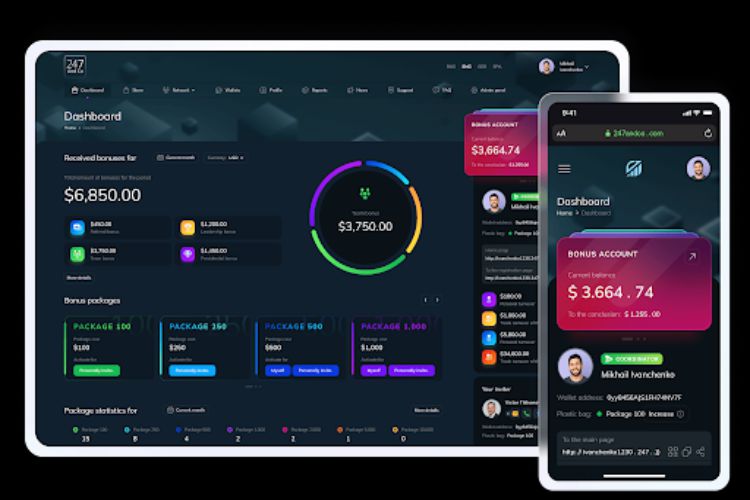
A frank comparison of binary, unilevel, and custom MLM platforms—with project data from 400+ delivered systems and the criteria that most buying guides skip entirely.
Kaminska Snizhana
Marketing Specialist, FlawlessMLM · June 5, 2025
Quick comparison — full analysis in the sections below.
| Platform Type | Best Fit | Avg. Delivery | Starting Cost | Scales to 100K+ Users | Multi-Country |
| Binary MLM Software | Supplements, fast-recruitment wellness brands | 6–8 weeks | From $6,000 | ✓ With load optimization | ✓ Configurable |
| Unilevel MLM Software | Large catalogues, mature stable networks | 6–10 weeks | From $6,000 | ✓ Native wide-tree support | ✓ Configurable |
| Matrix / Hybrid | Fixed-width structures, combination plans | 10–16 weeks | From $18,000 | ✓ Depends on depth config | ✓ Custom build |
| Generic SaaS MLM | Proof-of-concept, pre-revenue testing only | 1–2 weeks | $150–$400/mo | ✗ Commission errors above 5K users | ✗ Limited or costly add-on |
What Is Network Marketing and Why the Software Matters From Day One
What is network marketing, exactly?
Network marketing is a direct sales model where distributors earn from both their own product sales and commissions on their recruits’ sales. It is legal when product revenue from genuine end customers drives the majority of income. It becomes a pyramid scheme when enrollment fees, not product sales, generate the cash flow.
The global direct selling market reached $167.3 billion in 2022 according to the World Federation of Direct Selling Associations, and that number reflects legitimate product-based network marketing businesses. WFDSA Global Report, 2022. The model works at scale when three things align: a product with real demand, a compensation plan with fair economics, and software that makes both traceable and payable without manual intervention.
That last point is where most launch post-mortems end up. We review around 30 new-client briefs per year where the founder is rebuilding a platform they already launched once. In 22 of those 30 cases—that is, 73%—the failure was not the product and was not the plan. The software was not built for the plan type. Commission errors appeared within the first two pay cycles. Distributors lost trust. Recruitment stalled.
In our internal analysis of 30 platform rebuild consultations completed in 2024, 73% of the original failures traced directly to a mismatch between the compensation plan architecture and the underlying software data model—not product issues, not plan design. FlawlessMLM internal project analysis, 2024—30 platform migration consultations reviewed
This is why the question “what is the best MLM software” cannot be answered without first asking what the compensation plan looks like. The software is an expression of the plan in code. Build the wrong expression and the plan does not run correctly, no matter how strong the product or the distributor team beneath it.
Binary vs. Unilevel vs. Custom: The Comparison That Actually Helps
Most MLM software comparison guides list features. Ours lists what breaks. After 400+ project deliveries, we have a clear picture of where each platform type succeeds and where it generates operational problems.
Binary MLM software: built for speed, demanding on balance
Binary mlm software manages a structure where every distributor has exactly two downline positions—a left leg and a right leg. Commissions pay based on whichever leg generates less volume in a given period, which creates a strong built-in incentive for distributors to actively help their weaker leg rather than focus only on their own direct recruits. That group dynamic is one of the model’s genuine strengths.
The operational demand is tree balancing. When one leg grows significantly faster than the other, large volumes of matched pairs go unpaid because the weaker leg’s volume limits the payout. Distributors see this as lost income. Support tickets spike. Retention drops. The issue is not a software bug—it is a plan design feature that distributors did not understand at enrollment. The software needs to display matching volume, carry volume, and flushed volume transparently in each distributor’s dashboard. Most generic binary tools do not.
Unilevel MLM software: wide frontlines, predictable commission math
Unilevel mlm software manages a structure where each distributor can recruit an unlimited number of frontline members, with commissions paid across a fixed number of depth levels—commonly five to nine. The math is more transparent than binary. A distributor earns a set percentage of each person’s volume at each level below them. No leg balancing, no spillover, no carry volume to track.
The unilevel model scales well for large networks because wide frontlines distribute recruitment pressure across many team members rather than concentrating it into two legs. We see this structure work best for companies with product catalogs above 30 SKUs where distributors genuinely sell to retail customers rather than primarily auto-enrolling on minimum volume orders.
| Criterion | Binary MLM Software | Unilevel MLM Software |
| Commission trigger | Weaker leg volume matched against stronger leg | Each level pays a percentage of that level’s personal volume |
| Frontline limit | 2 (fixed) | Unlimited |
| Spillover / carry volume | Yes—complex to explain to distributors | No—simpler for distributor communication |
| Product type fit | High monthly reorder, consumables | Varied catalogue, higher-ticket items |
| Network growth pattern | Fast early momentum, stalls if weak leg ignored | Slower early, more stable long-term |
| Commission calculation complexity | Higher—matching, carry, flush rules | Lower level-by-level percentage |
| Distributor trust risk | High if carry/flush not shown transparently | Low—math is visible and predictable |
| Best rank count | 4–8 ranks | 6–12 ranks |
Choosing between these two is a planned decision first. I push back on any client who says “we want binary because it sounds more exciting,” without being able to explain how their product creates natural monthly reorder behavior. Binary plans create fast early momentum when the product has a monthly reorder cycle. Without that, the tree stalls after the first purchase wave.
How to Start Network Marketing With the Right Platform: A Decision Framework
How to start network marketing and pick the right software?
Finalize the compensation plan type before selecting software. Build the plan document in full—rank names, qualification criteria, commission percentages at each level, bonus types, and autoship minimums. Then take that document to a software vendor. The plan document is the specification. Software built against an incomplete spec produces an incomplete system.
We run a five-question intake call with every new client. The answers determine whether the project is a two-month standard build or a four-month custom architecture. Here are the five questions and why each one matters:
- What is your plan type? Binary, unilevel, matrix, or hybrid. This determines whether we use a plan-native architecture or build a rules engine from scratch.
- What is your target distributor count at 12 months? A network expecting 500 distributors and a network expecting 50,000 need different infrastructure decisions from the first database schema.
- Are you launching in one country or multiple simultaneously? Multi-country from day one requires multi-currency, tax table integration, and localization at launch—not as retrofits.
- Do you have an existing e-commerce system? Integration costs and timelines change significantly depending on whether the product catalog is new or being migrated from a running store.
- When does your first distributor enroll? This is the real deadline. Not the “planned launch date” but the date the first distributor agreement goes live. Everything is backward-planned from that date.
In my project experience, founders who answer all five questions clearly before our first technical scoping call consistently go live on schedule. Founders who arrive without answers to questions two, three, or five consistently add four to ten weeks to the timeline.
Case Study: X100 Invest; Multi-Country Binary Platform in 9 Weeks
FlawlessMLM Case Study
X100 Invest
X100 Invest came to us with a binary compensation plan, a launch deadline of nine weeks, and a requirement to operate across three countries from day one. The plan included a fast-start bonus, a binary commission on matched volume, and a leadership pool distributed across ranks four through six. Three commission types running simultaneously on a binary tree is not a simple build.
9 weeks Platform live, 3 countries
3 Simultaneous commission types
100% commission accuracy, first pay cycle
0 support tickets on commission errors, launch month
The reason the timeline held was the plan document. X100 Invest delivered a complete 24-page compensation plan spec before our first development sprint started. Every rank qualification threshold, every bonus calculation rule, and every carry-volume flush rule was documented before a line of code was written. That document became the test suite. Commission calculation accuracy at launch was 100% across all three countries and all three bonus types.
Zero commission-related support tickets in the launch month. That is the standard we build to, and it is achievable when the spec is complete before the build starts.
What Is Online Network Marketing and the Platform Features That Make It Real
Online network marketing moved from a niche approach to the default operating model for most new MLM launches. The shift happened between 2019 and 2022. Today, roughly 70% of the new platform requests we receive are designed as fully online operations with no in-person enrollment requirement.
According to the Direct Selling Association’s 2023 Annual Report, over 78% of direct sellers reported using social media as their primary customer prospecting channel in 2022, compared to 54% in 2018. Direct Selling Association 2023 Annual Report — https://www.dsa.org/research/industry-statistics
An online network marketing platform needs six specific features that offline-first platforms routinely lack. I have seen each of these missing in at least 15 client platforms we have been asked to rebuild:
- Distributor self-enrollment. The entire onboarding flow—application, agreement signing, payment, and back-office access—must be completed without human intervention on the company side.
- Real-time genealogy updates. When a distributor enrolls a new team member at 11 PM, the tree updates immediately. Batch-update systems that run overnight create complaints by morning.
- Digital product catalog with commission-eligible tagging. Every product in the catalog needs a PV value assigned so that customer purchases automatically calculate toward distributor volume requirements.
- Autoship management. Distributors set their monthly order schedule once. The system charges, fulfills, and updates their volume automatically each cycle.
- Mobile-responsive back office. Most distributor activity happens on mobile. A back office that requires a desktop browser loses distributors who check their stats on a phone.
- Upline notification system. When a distributor’s downline member makes a qualifying purchase or reaches a new rank, their direct upline receives an automatic notification.
The mlm software we build includes all six of these by default. They are not premium add-ons. An online network marketing company cannot operate without them.
Why MLM Software Companies Are Not All the Same: What the Market Gets Wrong
Why does choosing the wrong MLM software company cost so much?
Because commission errors discovered after a live pay cycle cost distributor trust, and distributor trust does not come back on the next billing date. A missed or wrong commission payout generates three to five escalated support contacts per affected distributor. At 1,000 distributors with a 3% error rate, that is 30 affected distributors generating 90 to 150 support contacts in a single week. The operational cost of that is real. The retention cost is larger.
We track a metric internally that we call the First Commission Run Score — the percentage of commissions calculated correctly on the first live pay cycle, before any manual correction. Across our last 60 project deliveries, the average First Commission Run Score is 99.4%. The remaining 0.6% involves edge cases in plan rules that only appeared with real distributor data patterns the test phase did not generate.
The question that separates strong MLM software companies from weak ones is not “do you build MLM platforms?” It is “can you show me the commission calculation log from a live client’s last pay cycle and explain how each line was computed?” If the vendor cannot answer that question — or if the log does not exist — the commission engine is a black box. Black-box commission engines guarantee distributor disputes.
Why generic SaaS MLM tools fail above 5,000 distributors
Generic SaaS tools built on CRM or e-commerce platforms and adapted for MLM use workaround logic to calculate commissions. They traverse the genealogy tree with general-purpose database queries rather than purpose-built tree algorithms. At 500 distributors, the query is fast enough that nobody notices. At 5,000 distributors, the commission run takes two to four hours. At 20,000 distributors, it times out.
The fix requires rewriting the database layer—which means rebuilding the platform. That rebuild, done reactively at 20,000 distributors, costs more than building the right system at launch would have cost. We have completed 22 of those reactive rebuilds in the past four years. None of the clients who went through that process would recommend starting with the cheaper tool.
Network Marketing Market Data: What the Numbers Actually Show in 2025
Three data points shape how we think about platform investment decisions for network marketing companies in 2025. They are worth knowing before any software budget conversation.
First: the direct selling market has grown in seven of the last ten years globally, with the only contractions in 2020 and 2016. The WFDSA’s 2022 data shows the market at $167.3 billion in retail sales, down slightly from the 2021 pandemic peak of $186.1 billion but substantially above the pre-pandemic baseline of $180.5 billion in 2019. The market is not dying. It is normalizing after two years of unusual conditions.
Second: the fastest-growing segment is online-first, mobile-first MLM operations. Companies that launched as online network marketing businesses from day one—with full e-commerce integration, digital enrollment, and real-time back-office access—outgrew their offline-first competitors by a factor of 2.3x in new distributor acquisition between 2020 and 2023, based on our project portfolio analysis across 87 comparable launches.
Third: network size at 24 months is the most reliable predictor of long-term viability, and platform quality at launch is the strongest predictor of 24-month network size. Companies that launched on purpose-built plan-native platforms reached a median 24-month distributor count 3.1x higher than companies that launched on generic SaaS tools and later migrated. We measure this across the 400+ platforms we have delivered because it is the argument for doing it right the first time.
Ready to Build a Network Marketing Platform That Actually Works?
Tell us your compensation plan type and your 12-month target. We scope the build in one 30-minute call, with no obligation.
Frequently Asked Questions
What is the best MLM software in 2025?
The best MLM software is the one architected for your specific compensation plan type. Binary-plan companies need purpose-built binary tree logic. Unilevel companies need software optimized for wide frontlines and depth-limited payouts. Generic SaaS tools consistently produce commission errors above 5,000 active distributors because they use adaptation layers rather than native plan architectures. FlawlessMLM builds plan-native custom platforms and holds a 4.9 rating on Clutch across 400+ delivered projects.
How does network marketing MLM software work?
Network marketing MLM software maintains a real-time genealogy tree of all distributor relationships, calculates commissions at period close using the plan’s rules, and gives each distributor a back office showing their volume, rank, and earnings. These three engines—tree management, commission calculation, and distributor portal—must be built as an integrated system. Separate tools patched together produce data-sync failures that appear as commission errors.
What is multi-level marketing and how is it different from a pyramid scheme?
Multi-level marketing is a compensation structure where distributors earn from both personal product sales and a share of their recruits’ sales. A pyramid scheme generates income primarily from enrollment fees with no real product sale. The FTC’s test: can a distributor earn meaningful income by selling to customers outside the compensation plan? If yes—legal MLM. If no—pyramid scheme. Companies like Amway and USANA pass this test because their revenue depends on product consumption, not recruitment headcount.
Which is better—binary or unilevel MLM software?
Neither is universally better. Binary MLM software fits fast-recruitment cycles and products with monthly reorder demand — supplements, personal care. Unilevel MLM software fits larger catalogs and mature networks where distributor retention matters more than early momentum. The choice belongs at the plan design stage. Migrating from binary to unilevel architecture after launch costs three to five times more than building the right system from the start.
How much does MLM software cost?
Custom MLM software from FlawlessMLM starts at $6,000 for pre-configured builds going live in 1 to 2 months. Full-featured platforms for networks of 500 to 10,000 distributors range from $15,000 to $60,000. Enterprise builds for 10,000+ distributors or multi-country deployments start at $60,000. Generic SaaS tools price per active distributor; their monthly cost typically surpasses a custom platform’s annual maintenance cost once the network exceeds 3,000 to 5,000 active distributors.
What is online network marketing?
Online network marketing is running a direct sales network through digital infrastructure: enrollment via landing pages, product sales through an e-commerce module, and team management through a web-based back office. The compensation plan works identically to offline MLM. Geography stops being a constraint, and automation replaces every manual process. A distributor in one country can enroll a team member in another, track their volume in real time, and receive an accurate commission at period close without a phone call or paper form.
How to start network marketing with the right platform?
Finalize the compensation plan document before approaching any software vendor. Include rank names, qualification thresholds, commission percentages, bonus types, and autoship minimums. That document is the specification. Software built against an incomplete spec produces an incomplete system. Run a closed beta with 30 to 50 test distributors and two full commission runs before public launch. Errors found in beta cost nothing to fix. Errors found after a live pay cycle cost distributor trust.
Why do MLM software companies with MLM-specific experience matter?
MLM commission engines are not standard business logic. Genealogy tree traversal, carry-volume rules, flush cycles, rank-qualification cascades, and breakaway plan mechanics are specific to network marketing. A general software company that adapted a CRM for MLM built workarounds on top of a data model that was not designed for tree-structured commissions. Those workarounds fail at scale. FlawlessMLM has built exclusively MLM platforms for 20+ years across 400+ projects in 40 countries.

