
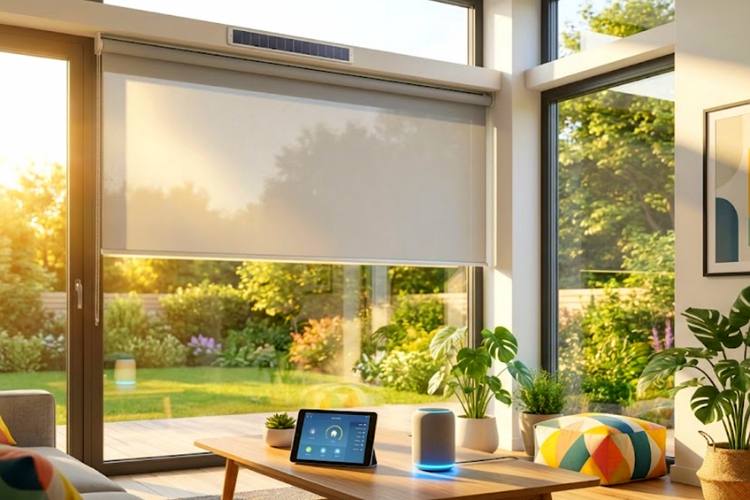
Privacy Has Changed Beyond Traditional Window Coverings
For decades, curtains and blinds have been the default solution for creating privacy in homes and offices.
They are familiar, widely available, and relatively straightforward to install. However, as modern interior design increasingly embraces open layouts, glass partitions, and natural light, many homeowners and businesses are exploring alternatives that offer greater flexibility.
One option that has gained significant attention is smart glass technology, particularly switchable smart film, which allows glass to change from transparent to opaque with the touch of a button.
The question is no longer simply how to block visibility, but which privacy solution best supports how a space is actually used.
Understanding The Different Approaches To Privacy
Although curtains, blinds, and smart glass all provide privacy, they achieve it in very different ways.
Curtains
Curtains create privacy by physically covering glass surfaces.
They offer:
- Full visual blockage when closed
- A wide range of fabrics and styles
- Additional decorative value
However, they also block natural light and may require regular cleaning and maintenance.
Blinds
Blinds provide adjustable privacy through movable slats.
They allow users to:
- Control light levels
- Adjust visibility
- Maintain some outside views
While versatile, blinds can collect dust over time and may require periodic maintenance depending on the system used.
Smart Glass Film
Smart glass film uses liquid crystal technology to change the appearance of glass instantly.
When powered, the glass remains transparent. When power is removed, the liquid crystals scatter light, creating an opaque appearance that provides privacy on demand.
This allows a single glass panel to serve both open and private functions without additional coverings.
The Biggest Difference Is Flexibility
The simplest way to understand the comparison is this:
Curtains and blinds cover glass. Smart glass transforms the glass itself.
Traditional window coverings require physical movement to open or close them.
Smart glass changes state almost instantly, allowing spaces to switch between transparency and privacy without altering the room’s overall design. Magic Glass, for example, utilises switchable film technology that can transform glass from clear to opaque within seconds.
For spaces that frequently alternate between open and private use, this flexibility can become a significant advantage.
How Natural Light Changes The Equation
One reason many modern spaces use glass is to maximise natural light.
When curtains are closed:
- Privacy increases
- Natural light decreases
Similarly, some blind configurations may partially reduce incoming light.
Smart glass approaches privacy differently. Instead of covering the glass, it allows light transmission while obscuring visibility, helping spaces remain bright even when privacy is activated.
This is one reason smart glass is increasingly used in:
- Offices
- Meeting rooms
- Bathrooms
- Healthcare environments
- Contemporary residential interiors
Installation Considerations
The installation process differs significantly between these solutions.
Curtains And Blinds
Typically require:
- Mounting hardware
- Brackets
- Tracks or rods
Installation is generally straightforward and familiar.
Smart Glass Film
One advantage of smart film is that it can often be applied directly onto existing glass surfaces rather than requiring complete glass replacement. This makes it a practical retrofit option for many renovation projects.
However, smart film also requires:
- Electrical connectivity
- Professional installation
- Proper planning for wiring and controls
Installation quality is particularly important because factors such as cabling, integration, and overall finish can affect the final user experience.
Cost Isn’t Just About Upfront Pricing
Many people assume the comparison begins and ends with cost.
In reality, the better question is often:
How will the space be used over time?
Curtains and blinds generally have:
- Lower initial costs
- Minimal technical requirements
Smart glass film typically involves:
- Higher upfront investment
- Electrical installation
- Professional setup
However, it also introduces functionality that traditional coverings cannot easily provide, such as instant switching, integration with automation systems, and maintaining a clean glass aesthetic.
The decision often comes down to whether that flexibility adds meaningful value to the space.
When Smart Glass Makes More Sense
Smart glass tends to be most suitable when:
- Privacy requirements change throughout the day
- Minimalist design is a priority
- Natural light is important
- Glass partitions are heavily used
- Smart home integration is desired
It is particularly common in:
- Meeting rooms
- Home offices
- Bathrooms
- Clinics
- Modern residential spaces
When Curtains Or Blinds May Be Enough
Traditional solutions may remain the better choice when:
- Privacy is needed constantly
- Budget is the primary concern
- Electrical installation is impractical
- The space is used infrequently
- Decorative styling is a major objective
In many situations, simplicity may be more valuable than technological flexibility.
Best Switchable Smart Glass Film in Singapore
1. Magic Glass
Magic Glass specialises in switchable smart film solutions for both residential and commercial environments.
Its smart film technology allows glass surfaces to switch between transparent and opaque states instantly, providing privacy on demand while maintaining a clean and modern appearance. The company also offers retrofit installations, allowing existing glass panels to be upgraded without full replacement.
Best for:
Homeowners and businesses seeking flexible privacy solutions that integrate with modern interior design.
Things to consider:
Smart film installations require professional setup and electrical connectivity for operation.
2. Pramie
Provides smart glass and switchable film solutions for residential and commercial applications.
Best for:
Property owners looking for privacy technology integrated into modern spaces.
3. House Of Glass
Offers a range of architectural glass and privacy glass solutions.
Best for:
Projects that combine glass design with functional privacy requirements.
Honest Customer Experience
When evaluating smart glass solutions, many homeowners initially focus on the technology itself. However, actual user experiences often highlight a different factor: whether the solution genuinely improves how a space functions on a daily basis.
One customer who installed Magic Glass smart film for a home study and kitchen-living divider shared:
“Chose Magic Glass Singapore to do up our home glass study and kitchen-living divider glass, the result is amazing. Now we have a well customized open concept and privacy home at just a click of the remote control. Very happy with the decision to go with Smart glass film. Installation was flawless and the team of Magic Glass were patient professionals who had to entertain my OCD level scrutiny at details.”
Experiences like this often reflect the practical appeal of smart glass. Rather than replacing traditional privacy solutions everywhere, many users find the greatest value in spaces that benefit from switching between openness and privacy throughout the day.
Final Thoughts
Smart glass, curtains, and blinds are all capable privacy solutions, but they serve different purposes.
Curtains and blinds remain effective, familiar, and cost-efficient choices for many situations.
Smart glass, however, offers something different: the ability to transform a space instantly without covering the glass itself. This flexibility can be particularly valuable in modern environments where natural light, open layouts, and adaptable spaces are priorities.
Rather than asking which solution is universally better, it often makes more sense to ask:
How often does the space need to change between open and private?
The answer usually makes the right choice much clearer.

