
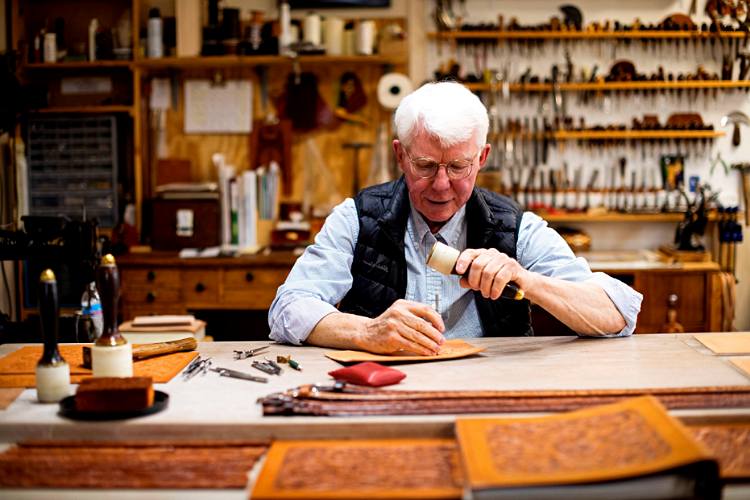
There is a deeply romanticized image associated with the term “handmade,” particularly in the world of fine leathercraft. The consumer envisions a solitary artisan, bathed in the warm light of a dusty workshop, meticulously tracing a paper pattern onto a pristine side of vegetable-tanned leather. The craftsman grips a razor-sharp head knife, holding their breath as they manually slice through the dense, organic fibers.
It is a beautiful narrative of analog purity. However, for the artisan trying to make a living, that romantic narrative eventually collides with a harsh physiological and economic reality.
Hand-cutting a single intricate wallet pattern is an act of craftsmanship. Hand-cutting that exact same pattern five hundred times to fulfill a wholesale order is not craftsmanship; it is an ergonomic nightmare. It breeds microscopic inconsistencies, generates massive amounts of wasted material, and practically guarantees carpal tunnel syndrome. To survive and scale, the artisan must inevitably look toward industrial machinery.
But this transition sparks a fierce philosophical debate within the maker community: the moment you introduce 20,000 pounds of hydraulic pressure to your workflow, do your products lose the soul of being “handmade”?
The Anatomy of the Clicker Press
To understand this debate, you have to understand the machine at the center of it: the clicker press.
The name itself is a historical ghost. In the 19th-century shoe factories of New England, workers manually cut leather parts using handheld knives guided by brass-edged wooden patterns. As the steel knife struck the brass edge, it made a distinct “click,” earning these highly skilled laborers the title of “clickers.”
When machines were eventually engineered to take over this grueling task, they inherited the name. Today’s modern clicker press replaces the hand knife with a “steel rule die”—a custom-bent ring of razor-sharp steel shaped exactly like the desired leather piece. The artisan places the leather on a cutting board, sets the steel die on top, and swings a massive, heavy metal arm (the striking head) over the die.
With the press of a button or the pull of a lever, hydraulic fluid rushes into a heavy cylinder. The machine effortlessly drives the striking head down, applying massive, instantaneous pressure to the back of the die. It punches through a quarter-inch of solid cowhide with the same effort it takes a human to cut a piece of warm butter.
The Economics of Perfect Geometry
For a growing workshop, transitioning to a machine like the cobra 10 ton clicker represents a profound shift in production economics.
When cutting by hand, the human element is a variable. A blade held at a slight angle creates a beveled edge that requires hours of sanding to fix. A slip of the wrist ruins a fifty-dollar piece of premium leather. Furthermore, human fatigue dictates output. A skilled worker might be able to hand-cut twenty complex bag gussets in an afternoon before their grip strength fails.
A hydraulic press eliminates the variable of fatigue. By utilizing 20,000 pounds of even, crushing force, the die creates an absolutely flawless, mathematically perfect 90-degree cut every single time. A craftsman can cut hundreds of identical pieces in an hour. More importantly, because the dies are rigid, the artisan can “nest” them tightly together on the leather hide, drastically reducing wasted scrap material between the cuts.
Read more about: Preparing Your Home for Long-Term Living and Aging in Place
Redefining the Artisan’s Value
This brings us back to the philosophical purity test. Does utilizing a hydraulic press strip the “handmade” title from a luxury leather good?
The answer requires a shift in how we value human labor. In traditional trades, we often conflate tedious physical suffering with authenticity. We assume that because a process was exhausting and difficult, it is inherently more valuable.
However, the true value of a master leatherworker is not found in their ability to endure the repetitive strain of tracing a cardboard template with an X-Acto knife. Their genius lies in the initial design of the piece. It lies in their expert understanding of the leather’s temper, knowing exactly which part of the hide to cut from to ensure the bag drapes correctly. It is found in the perfect tension of their hand-sewn saddle stitches, and the glass-like polish they achieve on the final burnished edges.
The clicker press does not replace the artisan; it emancipates them. By delegating the brutal, repetitive physics of raw material separation to a machine, the craftsman reclaims hours of their day. It preserves the cartilage in their wrists, allowing them a longer, healthier career. Most importantly, it frees up their time and mental energy to focus on the elements of the craft that actually require a human soul—the finishing, the assembly, and the artistry that a machine could never replicate.

